
Control of space starts with understanding
The UK has made Control of Space a strategic requirement. The hardest part comes before anyone acts: working out what is happening in orbit.
by Marco Rocchetto – CEO of Spaceflux
The new UK Space Strategy makes Control of Space a strategic requirement and names Space Domain Awareness as one of its four priority areas. It brings civil and defence space into one plan, backed by more than £7.8 billion to 2030, including £880 million of defence investment in intelligence, surveillance, reconnaissance and space control. The test now is delivery, and how quickly those budget lines become capability.
At Spaceflux we own telescopes which track satellites every night, and we use those observations to build a pattern of life for each one: where it usually operates, how often it manoeuvres, and what it normally does. Once you know what normal looks like, a change stands out, and you can start working out what it means before anyone has to decide how to respond. That is where understanding starts, and it gets harder as space gets more crowded.
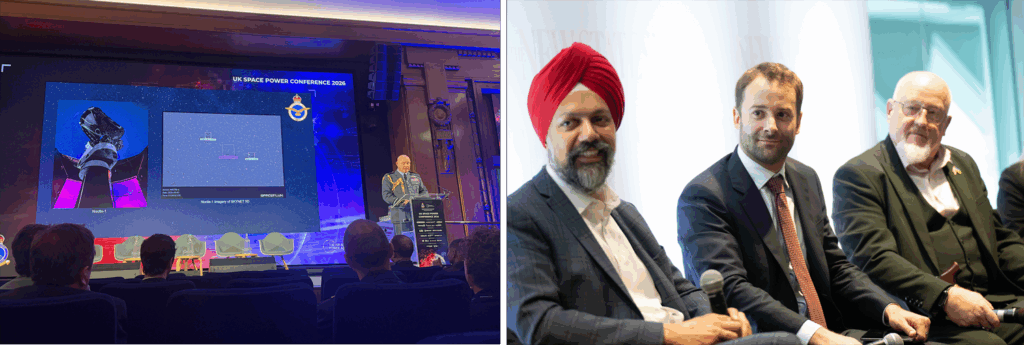
Air Chief Marshal Sir Harvey Smyth, the Chief of the Air Staff, gave an example at the UK Space Power Conference last week. In May, five Russian military satellites moved “within rapid reach of two Finnish commercial satellites”. On Tuesday I joined Luke Pollard MP, the Minister for Defence Readiness and Industry, on a UKspace and New Statesman panel at the Labour Party Conference, and he went further. He said space would be among “the first” domains to take a hit in a conflict, and that the UK should expect to lose capabilities in a way “we have never really had to think about before”.
A busier, more ambiguous sky
There are more than 15,000 active satellites in orbit today, and the strategy expects there could be up to 100,000 by 2030. Most of that growth is ordinary commercial activity, but some activity is deliberately ambiguous: a satellite drifts towards another and stops, or a spacecraft that has been quiet for months starts to manoeuvre.
Neither is an attack, but either could be the first step towards one. As the numbers grow, the challenge moves from finding objects to understanding what they’re doing.
Misreading and escalation
The strategy says space underpins the UK’s ability to “understand, decide, and act”. Understanding is the step the other two depend on: if we misread what a satellite is doing, every decision after that rests on the wrong foundation.
In a tense moment, a routine station-keeping burn mistaken for a hostile approach could provoke a response to something that never happened, and the same is true of how others read our own satellites.
As the Air Chief Marshal put it, “no one wants a war in space”. Avoiding one depends on spotting the warning signs early and reading them correctly, so that operators have time to think and respond with care. That’s why Space Domain Awareness belongs at the centre of Control of Space: it supports deterrence, and it reduces the chance of a misunderstanding turning into a crisis.
AI and intent
At the scale we’re heading towards, artificial intelligence (AI) is essential. No team of analysts can follow 100,000 objects by hand. AI makes it possible to keep a pattern of life for every satellite, flag the moment one departs from it, and suggest what the change might mean from what that satellite, and others like it, have done before. It also helps explain quickly what happened, and when an encounter stops short of an attack, the side that shows credible evidence first shapes how everyone else reads it.
Tracking can now say with confidence what a satellite did. Why it did it is much harder, for operators and AI alike. There are plenty of examples of hostile activity in orbit, from jamming and spoofing to satellites shadowing an ally’s spacecraft. But early in an approach, inspection, intelligence gathering and preparation for an attack can look the same, and there are few past cases that show which early behaviour led to which outcome.
Until that changes, the weight falls on experienced analysts, who have seen enough to recognise when something is genuinely new, and there aren’t enough of them. Dinz Dinsley, Managing Director of 3S Northumbria, made the point on Tuesday’s panel: an orbital analyst takes years to develop, and the job now needs an understanding of geopolitics as well as physics. The UK is investing in sensors and systems, and it needs to invest in the people who interpret them at the same pace.
Sovereignty
Tan Dhesi MP, who chairs the Commons Defence Committee, told the panel that the UK is “heavily dependent on the US for space surveillance information”.
The US is our closest ally. The strategy is still right to ask for capability that is “nationally separable”: the UK works with allies and commercial partners but keeps the technical ability to operate critical capability on its own when it needs to.
For Space Domain Awareness, that means Britain can point its own sensors and trust the answer, even on a day when an ally’s priorities differ from ours. The government can do that without building every telescope, as long as it controls the tasking and the data pipeline.
Defence as a service
The Minister also said defence will increasingly buy “defence as a service rather than space as an asset”, and that he expects to spend more on space over the next decade, but spend it differently.
Space Domain Awareness fits that model well. It underpins every space operation, and it has to be updated continuously from sensors spread around the world, because orbits change, new objects arrive and behaviour shifts. So it makes sense to buy it as a long-term service from a mission partner that keeps improving it.
The strategy already includes two ways to do this. It commits to publishing a cross-government demand pipeline for space, so that companies can invest ahead of need. And it creates the Enterprise Space Category, a single route for government to buy space services, starting with satellite communications. Space Domain Awareness would be a sensible next category.
Our own history suggests the approach works. Spaceflux’s first investor was UKI2S, a government-backed seed fund. With that early investment, and a customer that was clear about its requirements, we grew from a start-up into a supplier of sovereign capability. I’d like the next company to be able to make the same journey faster.
Control of Space will be tested in the first hours of a crisis, when someone has to decide what a manoeuvre means. The strategy has set the direction and the money. Whether the UK reads that moment correctly depends on the sensors, the analysts and the way of buying being in place well before it arrives.
PRESS RELEASE: Spaceflux selected for NATO DIANA’s Mission Track
Spaceflux has been selected as one of 15 innovators worldwide to advance into Mission Track of the NATO DIANA Accelerator Programme, the only Space Intelligence company chosen this year. LONDON, UK: Spaceflux Ltd, a UK based leader in Space Domain Awareness (SDA) and Space Intelligence, has been selected to advance into Mission Track – Phase…
PRESS RELEASE: Spaceflux and Mitsubishi Electric Corporation to explore space domain awareness collaboration in Japan
The two companies have signed a Memorandum of Understanding to assess opportunities to bring advanced space domain awareness capabilities to the Japanese market, as the United Kingdom and Japan continue to deepen their strategic partnership. LONDON / 17th Jun 2026 — Spaceflux, the UK space intelligence company, and Mitsubishi Electric Corporation (“Mitsubishi Electric”) have signed a Memorandum of Understanding (MoU) to explore…
Tracking Artemis II from the Ground
Photo Credit: (NASA/Joel Kowsky) On 1 April 2026, NASA’s Artemis II lifted off from Kennedy Space Centre, carrying a four-person crew toward the Moon for the first time since 1972. Over the nine days that followed, Spaceflux’s optical sensor network tracked the mission independently through every operationally significant phase, from the first hours after launch to the…
Newsletter signup
Stay informed about the latest advancements in optical space tracking, technology releases from Spaceflux Labs, and early access to new capabilities.